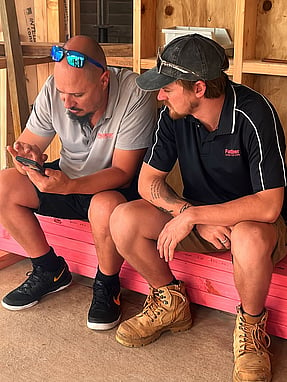
Our foremen used to unroll A1 plans on the bonnet of a ute.
Now they pull up the same drawings on an iPad, zoom into a detail, cross-link to a section, and keep moving. No flipping through pages. No hunting for the right revision. No version control chaos.
We moved to Procore a while back, and the change has stuck. Not because we told the team to adopt it. Because the team has come to prefer it.
The killer feature for adoption was practical. The team uses Procore to submit timesheets, and that’s how they get paid each week. But that was only the tip of a very deep iceberg.
That small detail matters. Most construction technology fails on site for one reason: the people using it don’t want to. The tech is fine. The rollout is where it falls over.
Why we chose Procore
The honest answer is the plan reader.
On an architectural build, your foreman might need to read a detail drawing, check its reference on a section, then jump back to the floor plan to make sure it all ties together. On paper, that means flipping between sheets, finding the right revision, and hoping nothing has changed since the last print.
Sometimes, it can be challenging to find the relevant sheet or revision number (maybe it hasn't even made it to site yet or the weather hasn't been playing ball and it's now damaged). With digital though, we always have the latest information on hand when we need it.
On the Procore app, it’s one tap. Zoom in. Cross-link to the section. Back to the plan. Everyone on site is looking at the same current document.
That’s not a marketing pitch. It’s what our guys told us when we asked how they wanted to work.
Technology on its own doesn’t change anything
Here’s the thing about construction tech.
You can buy the best software on the market. If the team isn’t committed to using it properly, and if the processes behind it aren’t well defined, it’s a useless investment. Worse, it becomes the thing everyone works around rather than with.
We think about this as a triangle. People. Process. Technology.
People who are committed to doing the work properly. Processes that are clear enough to follow without constant interpretation. Technology that supports both, rather than getting in the way. Take any one leg out and the whole thing falls over.
Procore wasn’t a silver bullet for us. What it did was put a useful spotlight on our people and our processes. We’ve kept investing across all three legs of the triangle since the rollout. That’s the work that makes the tech sharper.
What it looks like on site
The Craftsmen leadership group drives the culture. Our foremen set the tone on site. Our Project Financial Managers keep the cost side transparent. Procore is what ties the day-to-day work together.
Every drawing revision is current. Every RFI is logged and tracked. Every variation has a paper trail. Every inspection is recorded. Every photograph sits against the right project and phase.
When an architect asks us what happened on a particular day, we can show them. When a client asks why a cost moved, we can explain it with the documentation in front of them. When a consultant raises a question, we can answer it from the same data everyone else is looking at.
That visibility is what Procore gives us. It doesn’t make the decisions for us. It makes sure the decisions are based on the right information.
Why architects and clients feel the difference
For architects, the value is the audit trail. Every decision, every change, every communication is documented. If a question comes up three months down the track, the answer is in the system, not in someone’s memory.
For clients, the value is confidence. They can see what’s happening on their project, when it happened, and why. There are no surprises buried in an email thread no one can find.
For our team, the value is having all project information and communication in one platform. When everyone is working from the same current information, the day-to-day gets simpler and the work gets sharper.
Performing consistently well comes down to one thing. The more repeatable and scalable our processes are, the more reliably we can deliver. Procore is the engine that makes that possible.
Tech doesn’t build the house
Our carpenters still pick up the tools. Our foremen still lead from the front. Our Craftsmen still set the standards.
The technology doesn’t replace any of that. It supports it.
When people, process and technology all line up, good builders get sharper. Good processes get faster. Good decisions get easier. And the people doing the work can focus on the craft instead of the paperwork.
That’s the goal. The tech is just the enabler.
Designed by Architects. Built by Faulkner.
Frequently asked quetions
What is Procore?
Procore is a construction management platform used to manage drawings, documents, communication, costs and site activity across a project. It gives builders, architects, consultants and clients one source of current information - helping everyone work from the same plans and documentation.
Why does an architectural builder need construction management software?
Architectural homes are complex projects with multiple consultants, trades and decisions being made daily. A construction management platform keeps documentation current, tracks changes, and gives everyone on the project access to the same information at the same time.
Does Procore replace the need for experienced site leadership?
No. Technology supports good leadership - it doesn’t replace it. Strong outcomes come from experienced people, clear processes and the right tools working together. On site, foremen still lead the work and make the decisions. The technology simply helps them do it with better information.
How does digital project management benefit clients building a home?
Digital project management gives clients greater visibility and confidence. Decisions, changes and communication are documented, project information stays current, and there is a clear record of what happened, when, and why.
What does “people, process and technology” actually mean on site?
It means the team is committed to doing the work properly, the processes behind the work are clear and consistent, and the technology makes both of those easier rather than adding friction. Miss any one of those three and the other two don’t deliver.
Why do architects value digital project management on a build?
Architects value clear documentation and accountability. A digital platform creates an audit trail of drawings, RFIs, decisions and revisions, helping protect design intent and reduce confusion during construction.
══════════════════
Ross McConnell is Managing Director of Faulkner Construction, an award-winning Auckland builder of homes designed by Architects.
Ross brings an engineering and business background, including a Berkeley MBA and years leading growth-stage companies, along with deep respect for the craftsmen who bring complex architectural buildings to life. He's interested in what makes a great build work beyond the craftsmanship: how builders, architects and clients work together, how cost and risk are managed, and how disciplined people, processes and technology create better outcomes.
Ross is leading Faulkner towards a simple but ambitious goal: to be recognised as New Zealand's best builder of homes designed by Architects.
Connect on LinkedIn · Build with Faulkner
══════════════════