The conversation nobody wants to have with the builder
A few weeks ago, near the end of a large architectural build, we sat down with the architect and the clients to talk about contingency.
It was a conversation that should have happened much earlier. No one ever wants to talk to the builder about contingency. Architects will tell you the same. When it does come up, the reasoning is usually the same: that raising it somehow gives the builder permission to go over budget. That’s the real issue with contingency on architectural builds. Not that a system for managing change is missing. The conversation itself is missing.
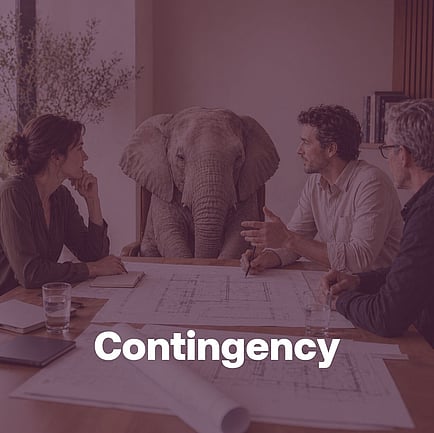
Contingency is the elephant in the room
On paper, by the time a build starts, everything feels resolved.
The design has been developed. A tender has been run. A price has been agreed. The project looks certain.
Then construction starts and reality sets in. Site conditions show up. Trades need to be coordinated. Buildability decisions surface. Small things the drawings couldn’t fully resolve have to be worked through.
That’s not a failure of design or a failure of pricing. It’s the nature of building complex, one-off homes.
But because contingency rarely gets discussed openly at the start, there’s no shared understanding of how that reality will be handled. Clients hear about a change and it feels like something has gone wrong. Architects can feel defensive about their documentation. Builders feel like they’re constantly breaking bad news, even when the project is actually being well managed.
The contingency is always there. What’s often missing is the agreement around it.
Why the conversation gets avoided
There’s a reason the contingency conversation rarely happens.
From the client’s side, raising it can feel like inviting things to go wrong. From the architect’s side, it can feel like questioning the design. And from both sides, there’s the concern the architect put words to: that talking about contingency with the builder will somehow give them a license to go over.
So, everyone avoids it.
The result is a build where change is still happening, costs still move, and decisions still need to be made, but without a shared framework for how to handle any of it. That’s when trust starts to erode. Not because the project is failing, but because nobody aligned on what success actually looks like when the unexpected arrives.
What the conversation should actually cover
There are really only two things that matter early on.
The first is an open, honest conversation about contingency itself. What it is. Why it exists. What a reasonable allowance looks like for this particular build. Who owns the risk on provisional sums. What might happen if the design evolves during construction.
The second is an agreement, upfront, about how change will be managed within that allowance. How variations will be documented. How cost impact will be presented. Who makes the call, and when.
That’s it. Two conversations. Neither is complicated. Neither needs to be adversarial. But without them, contingency becomes a topic that only comes up when something has already happened, which is the worst possible time to be having it.
The shift when the conversation does happen
Back to that meeting at the end of the build.
Once the avoidance was acknowledged, the tone shifted. We were able to look at the project honestly, in the context of its actual complexity and the unknowns we'd worked through.
The outcome was well within the realms of success. But without that frame, every conversation about budget had been landing as though the build was failing.
That's the signal. The conversation should have happened much earlier.
How we approach it at Faulkner
We’d rather raise contingency at the start of a project than manage around it later.
Every Faulkner project has a dedicated Project Financial Manager whose job is to keep cost visible and conversations open. Variations are documented, and cost impacts are presented before work proceeds wherever it's practical to do so.
None of that is unusual in itself.
What makes the difference is having the first conversation early, so the process has somewhere to live.
Change doesn’t disappear because a tender has been run. It shows up differently depending on whether the team has agreed how to handle it.
Alignment matters more than any system
Strong outcomes on architectural builds come from alignment, not just process.
Architects bring the design intent. Builders bring the delivery. Clients bring the brief and the decisions. When all three are aligned on how contingency will be held and change will be managed, projects run better. Not because nothing unexpected happens, but because when it does, the team already knows how to respond.
The goal isn’t to eliminate change. The goal is to be ready for it, together.
The conversation is the work
If there’s one shift worth making on architectural builds, it’s this.
Don’t avoid the contingency conversation. Have it early. Have it with the builder in the room. Agree what it covers, and agree how change will be handled against it.
That one conversation does more for a project than any system ever will.
Designed by Architects. Built by Faulkner.
Frequently Asked Questions
What is contingency in a building project?
A financial allowance set aside to cover changes, unknowns, or decisions that can’t be fully resolved until construction is underway. It’s a normal and necessary part of any architectural build.
Why is contingency needed if the design is complete?
Even well-developed architectural documentation can’t anticipate every site condition, coordination detail, or buildability decision. Contingency provides the space for those to be resolved properly, without destabilising the project.
Does talking about contingency mean I’m giving the builder permission to go over budget?
No. Avoiding the conversation is what creates problems. An open discussion about contingency, and how change will be managed within it, actually provides more cost certainty, not less.
Who should be part of the contingency conversation?
The client, the architect, and the builder. All three need to be aligned on what contingency covers and how change will be managed, before construction starts.
How does Faulkner manage change during a build?
Every variation is documented. Every cost impact is presented before work proceeds. A dedicated Project Financial Manager keeps cost visible throughout the build, so decisions are always made with clear information.
══════════════════
Ross McConnell is Managing Director of Faulkner Construction, an award-winning Auckland builder of homes designed by Architects.
Ross brings an engineering and business background, including a Berkeley MBA and years leading growth-stage companies, along with deep respect for the craftsmen who bring complex architectural buildings to life. He's interested in what makes a great build work beyond the craftsmanship: how builders, architects and clients work together, how cost and risk are managed, and how disciplined people, processes and technology create better outcomes.
Ross is leading Faulkner towards a simple but ambitious goal: to be recognised as New Zealand's best builder of homes designed by Architects.
Connect on LinkedIn · Build with Faulkner
══════════════════